


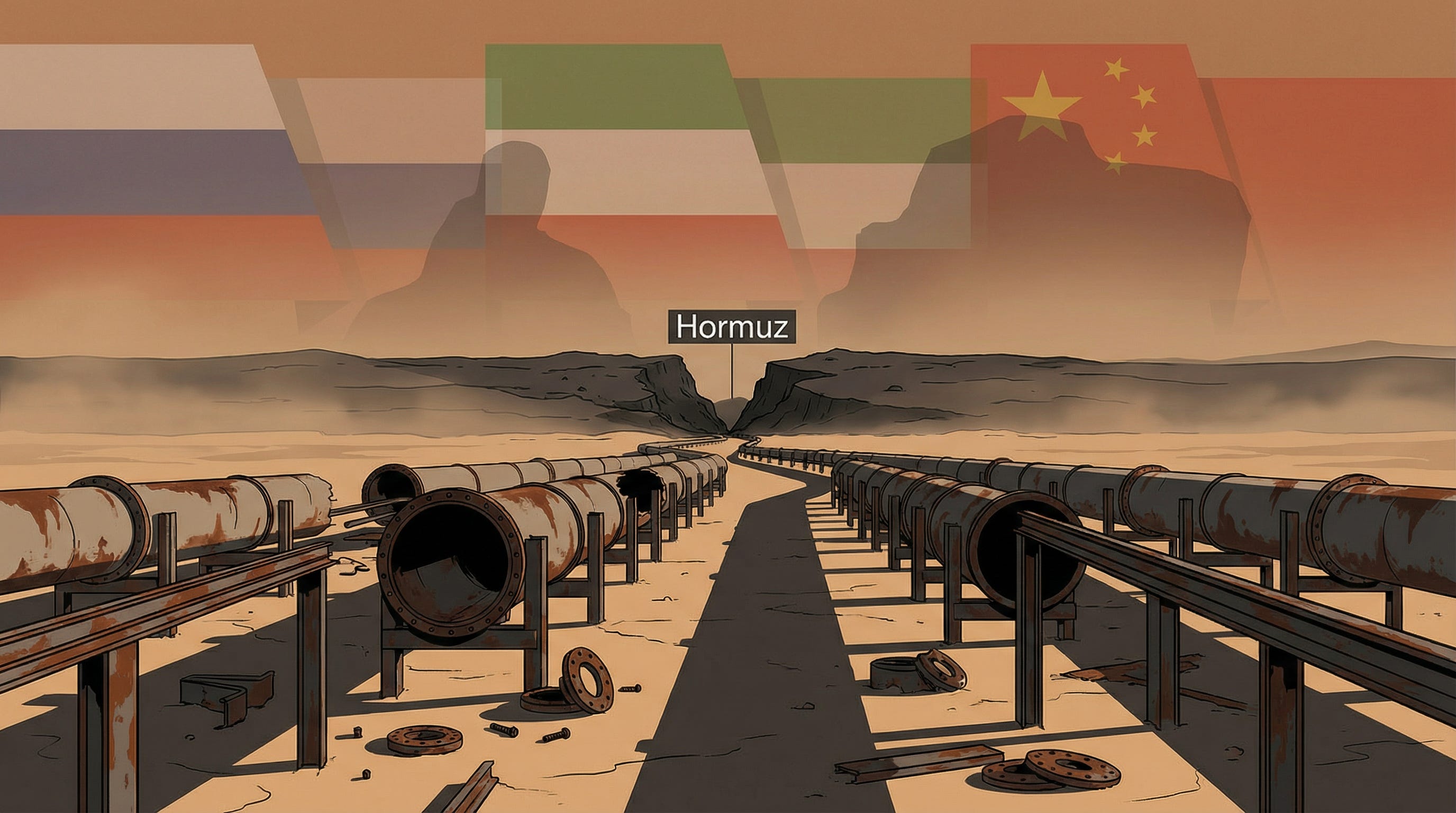
The de facto closing of the Strait of Hormuz is just the visible part of a much older story: everyone wanted cheap, reliable energy and geopolitical leverage, and nobody wanted to pay for boring, unsexy infrastructure. Gulf monarchies underbuilt the pipelines and redundancy their own exports depend on. Russia and Iran, with Chinese help, quietly stitched together a north–south corridor that now moves weapons south as easily as it does north. Asia is sweating over supply, Russia is smiling at higher prices and deeper dependency, and the United States is discovering that despite its firepower, the only thing saving it from a much uglier oil price shock is a quietly competent move in Venezuela.
Gulf producers have had four decades of warning that the Strait of Hormuz is a single point of failure for their exports and for Asia’s imports. They had the money, the time, and the engineering capacity to build serious inland redundancy: buried pipelines that bypass Hormuz entirely by running from the Gulf to the Red Sea, Arabian Sea, or the Mediterranean, plus storage and alternative ports. Instead, they built partial fixes and stopped. Saudi Arabia built and upgraded its East–West pipeline to Yanbu, and the UAE built a line to Fujairah on the Gulf of Oman. These projects are not nothing—but they are nowhere close to enough. When the Strait goes dark or becomes economically unusable, the system breaks. Storage fills, output is shut in, and global prices spike. That is not a technical failure. It is a political choice. Gulf ruling coalitions preferred prestige weapons and mega‑projects over buried steel in the desert, preferred free‑riding on American sea control over paying for true redundancy, and preferred “good enough to reassure traders” over “robust enough to survive the tail risk everyone can see.” In strategic terms, it is malpractice.
The United States owns the one piece of the system almost nobody else can replicate: the ability to project power into the Gulf, normally keep sea lanes like Hormuz open, and devastate a regional opponent if it chooses. For decades, US policy in the region boiled down to securing those sea lanes with naval and air power, containing adversaries like Iran, and selling arms and maintaining bases with friendly monarchies. What Washington did not do was integrate energy infrastructure into its security strategy. It never made serious Hormuz‑bypass capacity a condition of security guarantees or arms sales. There was no “build several million barrels per day of buried inland pipe to the Red Sea by year X, or the carrier group goes home.” Instead, the US implicitly promised: we will keep the strait open. That is the guarantee the Gulf built around, and it is the guarantee Iran is now calling into question. But there is one area where Washington actually thought ahead, and almost nobody is talking about it.
Before the current Iran war upended the Gulf, the US did something surprisingly competent: it started reopening Venezuelan oil. Through a mix of sanctions relief, licenses, and quiet deals, Washington let major Western firms step back into Venezuela’s oil patch. Output from one of the world’s largest reserve holders, previously strangled by sanctions and mismanagement, is now on track to climb back up toward and beyond one million barrels per day under US‑linked operators. That adds non‑Gulf, Western‑aligned barrels to the system just as the Gulf becomes unreliable while reducing the share of Venezuelan oil flowing to China. It gives Washington a flexible swing‑supply lever it can nudge without begging Moscow for relief. Venezuelan oil is not a full substitute for flows that normally move through Hormuz, but it is a rare example where policymakers priced in a future crisis and quietly pre‑positioned supply before lighting the match.
The other big players in this drama are Russia and China, and they have spent years building the plumbing that now underpins Iran’s ability to exploit the crisis. Russia and Iran, with Chinese help, deepened the Volga–Don and Caspian routes and built out a north–south corridor for trade and sanctions evasion. Iranian drones and munitions flowed north to Russia for use in Ukraine; now the same corridor can move Russian missile technology and components south into Iran. The Caspian and Russian river system is effectively untouchable. Hitting a Russian ship there would be a deliberate attack on Russian territory—an escalation nobody in Washington or Brussels is eager to test. For Moscow, a constrained Gulf and partially shut Strait of Hormuz are almost pure upside: higher global oil prices support Russia’s war budget, China and India become more dependent on Russian barrels, and US attention and resources get pulled into yet another theater. Beijing’s position is more awkward. It helped build out the Volga corridor, invested heavily in Iran, and talked up a “multipolar” order, but it also needs cheap, reliable Gulf oil moving through Hormuz more than almost anyone. It cannot openly line up with Washington to pressure Iran without shredding its political narrative. The result is a China that watches its own energy lifeline get more fragile, in part because of the partnerships and infrastructure it helped create.
Strip away the rhetoric and you get a simple picture. Asia—especially China—is structurally dependent on Gulf flows that pass through Hormuz and has no comparable ability to secure them by force or to reroute them overland. The Gulf monarchies treated vital redundancy and genuine Hormuz‑bypass capacity as an optional luxury, not a core requirement. Russia has every incentive to quietly feed the fire so long as it does not draw direct retaliation. And the United States, for all its errors, still controls the only credible military machine that can meaningfully shape outcomes in the Gulf and has quietly added some non‑Gulf supply back into the system via Venezuela. If you are in Beijing, this is a nightmare. If you are in Washington it is a brutal reminder that dominance in the Middle East still matters, that boring infrastructure decisions upstream of a crisis can be the difference between absorbing a shock and being broken by it, and that real hegemony is not just about ships and bases—it is about coaxing allies and clients to build the pipes, storage, and other infrastructure that keep their economies running when a chokepoint like Hormuz is contested.
Every actor in this story made the same error. The Gulf, Europe, and China trusted the US Navy and skimped on inland pipes that could have bypassed the Strait of Hormuz. The US likewise trusted its own military and skimped on integrating energy infrastructure into strategy—Venezuela being the rare exception. The global system did not fail because people lacked cleverness or models. It failed because everyone preferred prestige projects and short‑term comfort to buried steel, storage tanks, and redundancy that never show up on campaign posters or propaganda videos. Empires stumble when they refuse to pay for the dull, expensive infrastructure that makes their grand strategy survivable when the black swans finally arrive.