

Two Ethics, One Hierarchy
Aristotle and Christianity as Class Ethics, Not One Moral Tradition

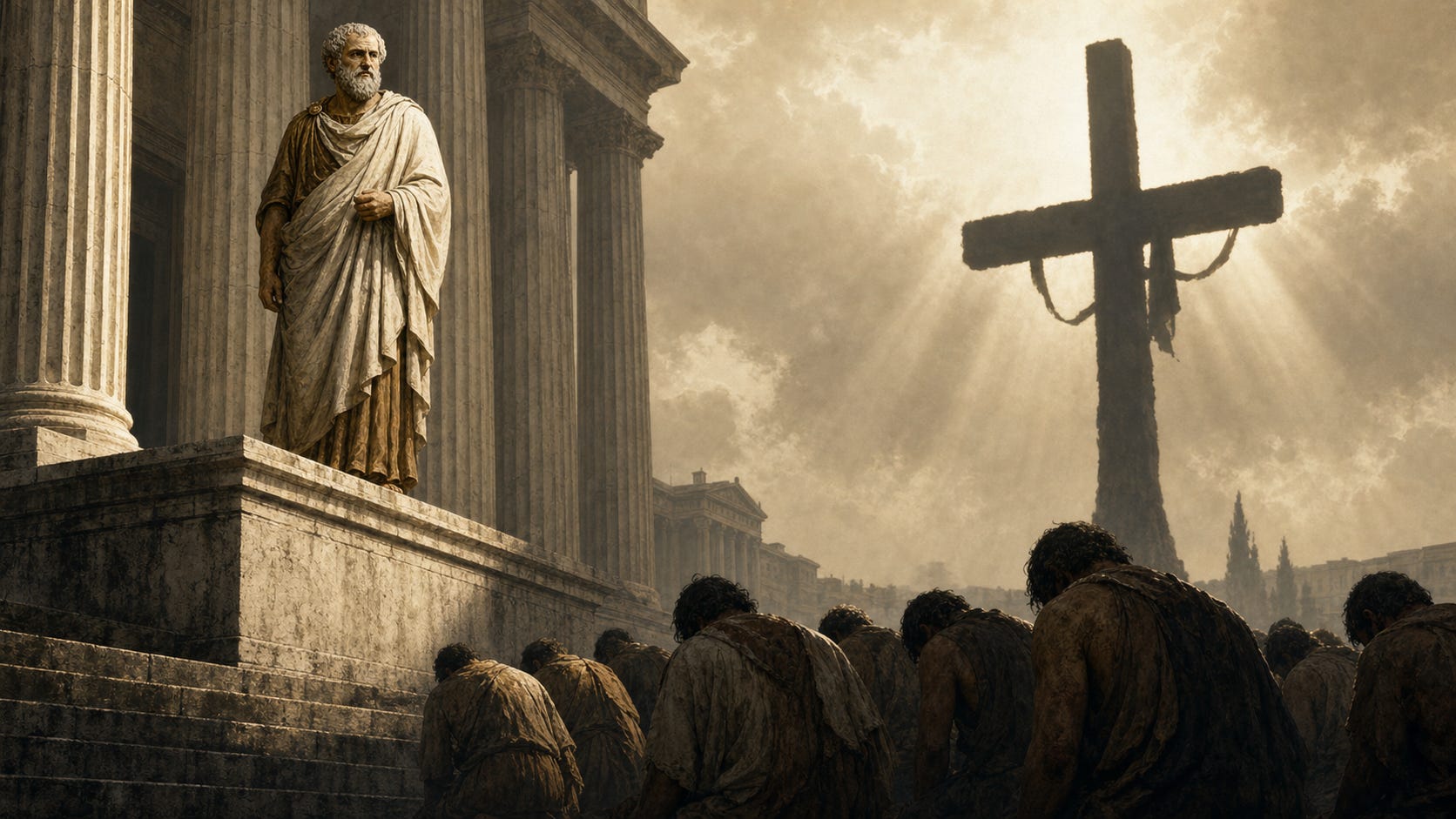
Aristotelian ethics are written for citizens in power. Christian ethics are the opposing image of virtue, an ethics written for subjects in the polis under power. Citizens are trained to dominate. Subjects are trained to submit.
That is why these two systems have been married so successfully. They do not belong next to each other as if they were similar ethical traditions or parts of one continuous moral philosophy. They belong next to each other because they stand in oppositional symmetry. They are complementary halves of a complete political theory of hierarchy.
This is the point that destroys the fantasy of a unified Western moral tradition. Aristotle and Christianity do not cohere on what virtue is, who it is for, or what the good life consists in. Aristotle ties ethics to the cultivation of excellence and political participation among citizens, while prominent Christian teachings center submission to authorities, endurance of suffering, and imitation of Christ under unjust power. They can be made to function together only in a class-divided political order. Their unity is not philosophical. It is political. It is the unity of hierarchy.
Aristotelian virtue ethics is rooted in the idea that humanity’s primary comparative advantage over other creatures lies in our capacity for reasoned activity; so the highest human excellence is the sustained cultivation and exercise of that capacity. Therefore, his ethics is one whose primary focus is the cultivation of individual excellence (virtue) and honor (admiration) through reason by recognizing and aiming at a mean of disposition and action, neither deficient nor excessive, aimed at citizens (those who rule and are ruled in turn) for the benefit of the community of the ruling elites (the common good). This pursuit requires the domination, subordination, and moral shaping of the city’s subjects, through laws, in pursuit of the good life, where slaves function as a necessary component to enable leisure for elite flourishing. It is not an ethic for the slave, the subordinate, the excluded, or the mass of the ruled. It is an ethic for those inside the circle of civic dignity, whose lives are bound up with offices, honors, judgment, and rule.
Christian ethics, by contrast, is directed toward those under power. Its central image is not the magnanimous citizen cultivated through reason who knows his worth and receives honor accordingly. Its central image is Christ suffering, submitting, enduring humiliation, refusing retaliation, and commanding his followers to do likewise. In major New Testament-based teachings often preached today, Christians are told to be “slaves of Christ” (Ephesians 6:6), submit to governing authorities, honor rulers, and endure unjust treatment in a Christlike way. Christian moral formation, at least in its dominant historical and political use, is an education in how to bear wrong, not how to cultivate admirable excellence by worldly standards.
That is why the two fit so well in practice. Aristotle trains the rulers. Christianity trains the ruled. One gives a code of excellence to those who govern; the other gives a code of submission to those who must live under governance, calling it excellence. One moralizes power from above. The other moralizes suffering from below.
This is not a unified ethic. It is a social division of moral labor. These moral systems line up only because each serves a different class: Aristotelian virtue guides the citizen and Christianity guides the subject.