


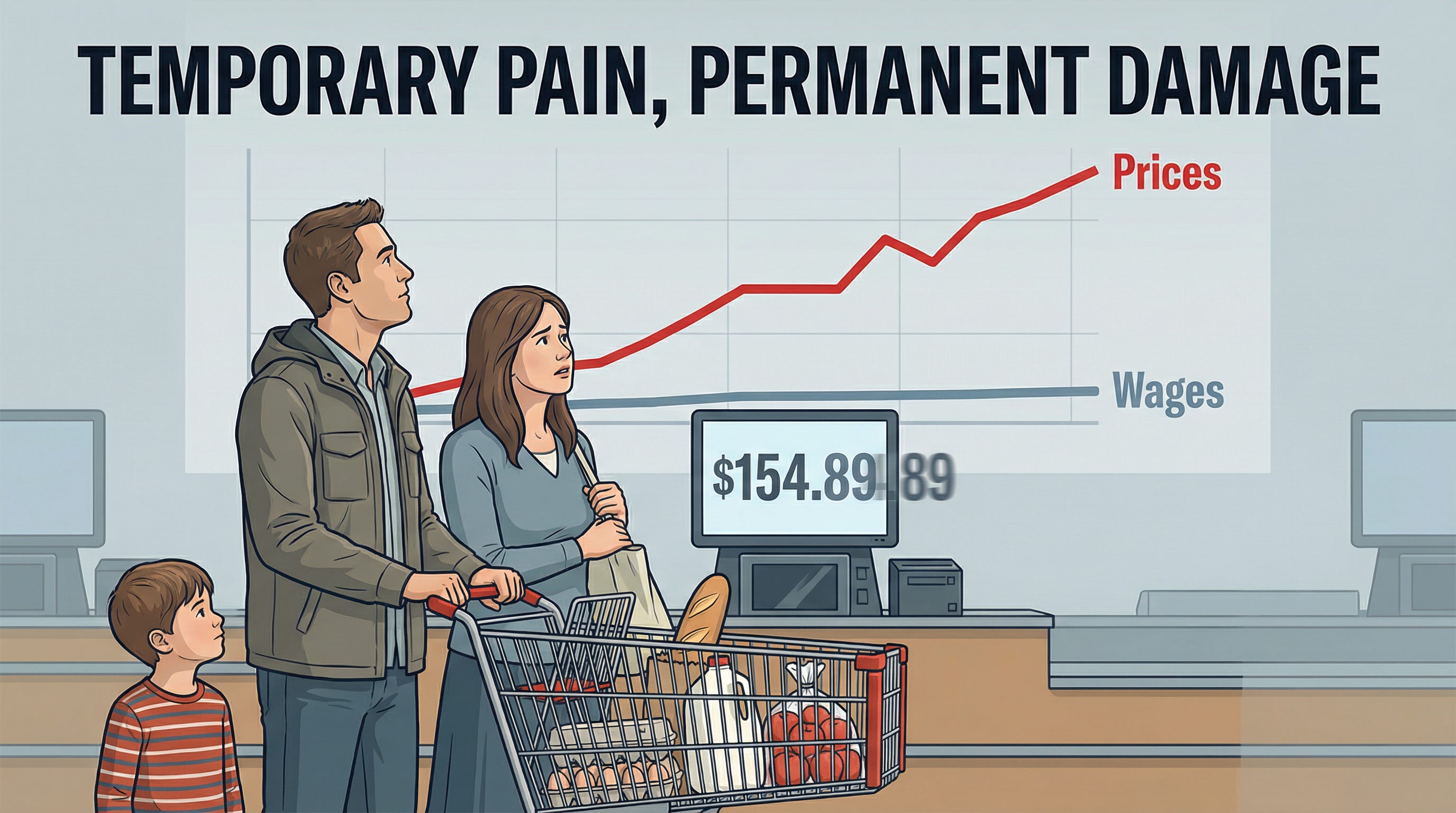
Every time gas prices spike or another brutal cost‑of‑living number hits, someone in power steps in front of a camera to reassure us that it’s “temporary,” “manageable,” and just a bump in the road. The message is always the same: calm down, citizen, the elites have it under control. But they don’t, and worse, they don’t understand the stakes. What we are living through is not just a bad few years or a normal business cycle. It’s a long, grinding process that erodes the people who actually keep the system standing—financially and militarily—while the beneficiaries of that system float above it and externalize hardship. The American “middle class” is being pushed toward functional poverty, and the people in charge can’t seem to grasp that their own commercial interests ultimately depend on those same people having the resources to fund the federal government. They are sawing off the branch they are sitting on. The astonishing part is that most of them don’t even seem to realize it.
The first trick is the way they talk about inflation. When they say a price spike is “temporary,” they’re technically talking about the year‑over‑year rate, not the actual day‑to‑day reality. Inflation doesn’t “pass” the way a storm does; it bakes in. If prices jump twenty to twenty‑five percent over a handful of years, that’s a permanent step up in the cost of staying alive. Even if the official inflation rate drifts back down to two or three percent after that, the new, higher price level doesn’t roll back—it just creeps up from a worse starting point. Every “good” year of two percent inflation, the official target of the Federal Reserve, is two percent on top of the previous damage. Officials love to talk in year‑over‑year percentages because it sounds technical and contained. “Inflation is now only 2.5 percent” gets offered as proof that things are under control. For normal people, that stat hides the real story: your dollar buys dramatically less than it did five years ago, and wages haven’t risen to make up the difference.
The second trick is how they talk about the middle class. On paper, the American middle class is supposedly “doing fine.” Look at the definitions used by major institutions and you’ll see the game. Most define “middle class” as a band of income around the national median—say, from two‑thirds of the median to twice the median. By that method, there will always be a middle class. As long as some median income exists, you can carve out a chunk around it and declare that chunk to be “middle class.” The share of people inside that band might wobble a bit, but in broad strokes it stays around half the population. That lets them say, with a straight face, that the middle class is “stable in size.”
What this definition never asks is whether that income can support a recognizably middle‑class life. You can sit comfortably inside the statistical “middle” and still be unable to buy a modest home where you live, still be one medical surprise away from financial disaster, still be taking on debt just to keep a car on the road and groceries in the fridge. Statistically, you are middle class; practically, you’re hovering just above poverty and living with constant financial anxiety. The category survives; the way of life that category used to imply does not. When leaders say “the middle class is stable,” what they really mean is that the middle slot in the hierarchy still exists. They do not mean that a stable, asset‑building, upwardly mobile middle‑class life still exists for most people. The gap between those two meanings is not an accident. It’s a sleight of hand that protects the story that America is still a middle‑class nation long after that stops being true on the ground.
Inflation, in this context, is not just a random economic shock. It’s a quiet wealth transfer. Prices jump. Wages lag behind. Debt stays fixed in nominal terms, but your capacity to service it gets squeezed. Meanwhile, financial and property assets often recover and increase. The people who own the assets are rarely the ones living paycheck to paycheck. Over time, the cumulative effect is simple: the money doesn’t evaporate; it migrates upward. The income and wealth share of the top climbs steadily, while a growing slice of “middle‑income” households cannot cover basic local costs without strain. You end up with families who, on paper, look perfectly “middle class” in income tables, but in real life are one rent hike, one illness, or one broken transmission away from tumbling into real hardship. It’s more accurate to say the middle class has been hollowed out than to say it has shrunk. The shell of the category remains, because the definition keeps it there. The security, the margin for error, the sense of future—those have been leaking out year after year.
Here’s the part almost nobody will say out loud: by impoverishing ordinary Americans, you are directly eroding the world economic order and security that elites themselves depend on. The people being squeezed are the same people who finance the United States military that protects elite wealth and lets them do business anywhere on the planet. It’s not just that the public funds roads and schools. Their taxes bankroll alliances, bases, carrier groups, intelligence networks, and covert infrastructure that keep trade routes open, enforce contracts, and push physical danger far away from corporate boardrooms and gated communities. The “rules‑based order” the top likes to invoke is, in practice, a massive security service underwritten by the very households now being told to eat permanent hits to their standard of living as if it’s a passing inconvenience.
When gas spikes and basic living costs jump again, it’s not a minor blip in a spreadsheet. It’s another cut into the same base of taxpayers that the entire system rests on. The poorer those people get, the less able they are to keep paying for a global security umbrella that mostly serves the interests of private organizations. You cannot bankrupt the people who fund your military and expect that military to keep guaranteeing supply chains, assets, and personal safety forever. Every notch down in the real standard of living is also a notch down in the credibility and staying power of the security architecture that protects elite interests. Put bluntly: the more hollowed out Americans at the bottom and in the middle, the less stability, security, and commerce are ultimately afforded to those at the top.
The danger here isn’t just greed; it’s also an elite ivory‑tower disconnection from reality. For many in the upper strata, their income is high enough that price spikes are an annoyance, not a constraint. Their assets often appreciate faster than inflation. Their social circles are narrow enough that they rarely see anyone choosing between gas, rent, and groceries. They live inside a curated reality where macro indicators look “fine,” the stock market is treated as a proxy for national health, and “year‑over‑year inflation is back to normal” is taken as proof that the problem is solved. The people whose job should be to warn them—policy analysts, think‑tankers, “thought leaders”—mostly come from the same social layer and speak the same safe language. The feedback loop is broken. The only people who can really feel what’s happening are the people whose signals never make it to the places where decisions are made.
From the top down, this still looks like turbulence. From the middle, it feels like the social contract coming apart in slow motion. The elites are not just indifferent to that crack in the branch; many of them genuinely don’t see it. They’ve convinced themselves that as long as the charts look stable, the society underneath will remain stable too. They measure the health of the order by GDP, never by how many people in that supposed “middle class” can actually cover a surprise expense, buy a modest home, see a prosperous path upward for their kids, or have jobs that keep up with inflation so the war machine can keep turning. Elites forget that the global order they treat as their playground is ultimately underwritten by the very people they keep telling to take one more “temporary” hit.
The real question is not whether a particular gas spike is “temporary,” or whether next quarter’s inflation print ticks up or down. The real question is how far you can hollow out the people who fund and fight for your system before they stop doing it. No one in charge seems keen to ask that question honestly, because any serious answer points toward changing how wealth, risk, and sacrifice are distributed. It’s much easier to keep changing the subject—to point back to year‑over‑year inflation, to point to the statistical middle class still existing, to point to the size of the markets and the military—as if those things can float forever above the people whose lives make them possible. They think they’re managing a bit of noise in an otherwise healthy system. In reality, they’re steadily cutting through the branch they’re perched on, mistaking the creaking sound for the wind.