

Neo‑Colonialism and the Democratic Coalition’s American Project

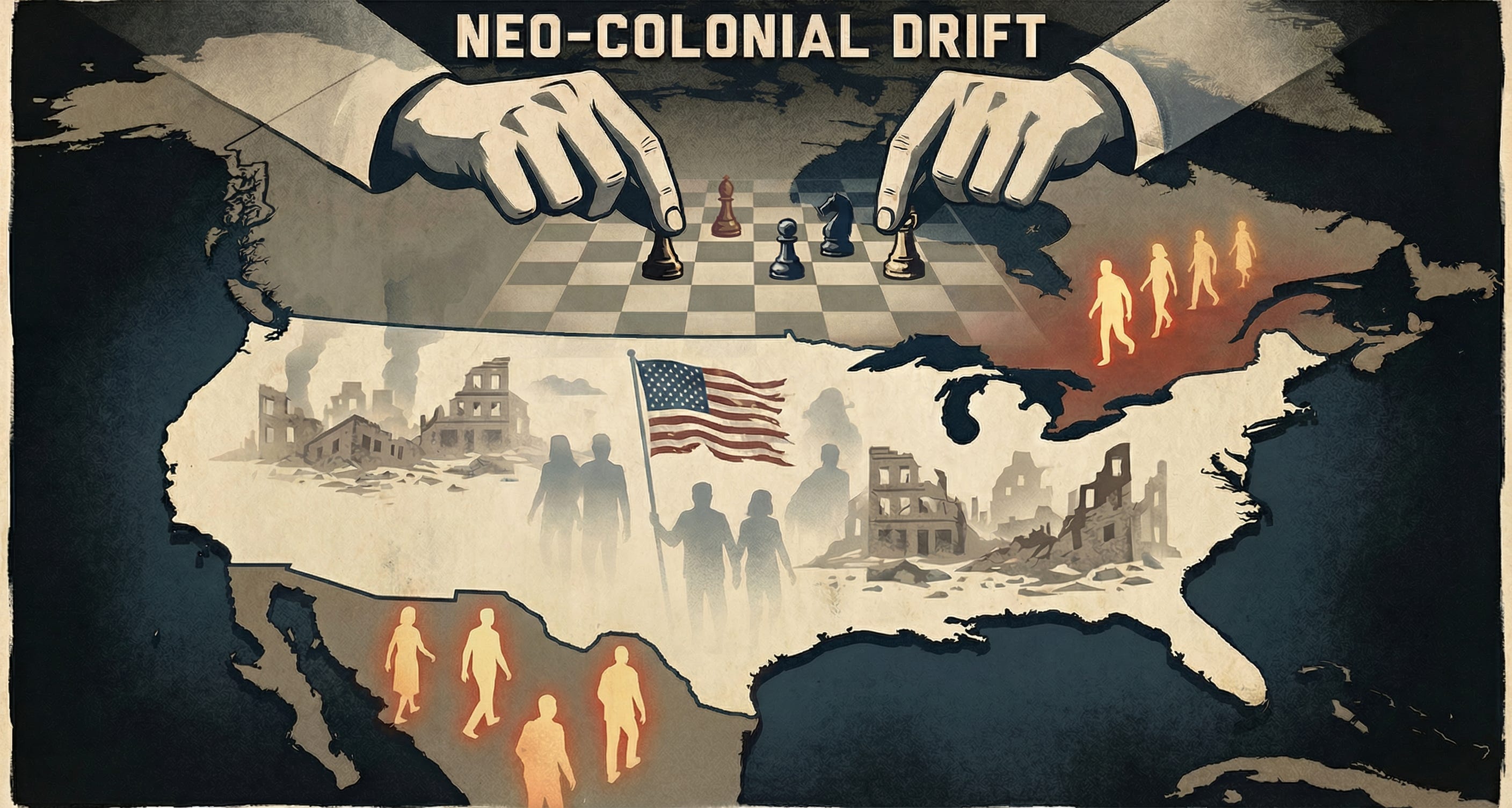
Progressive rhetoric insists that America is a “colonizer nation” and that today’s Democratic Party is finally dismantling that legacy by siding with migrants and refugees. In this script, Republicans and agencies like ICE and Border Patrol are the villains, and anyone who insists on a firm border is cast as an oppressor. The moral stakes are framed as simple: enforcement is cruelty, resistance to enforcement is justice for the oppressed.
Look closely at how the system actually functions and the story reverses. What emerges is not the end of colonialism but a new version of it. The existing American population is treated as a problem to be managed, while those who cross the border illegally or remain in violation of the law are treated as the morally privileged population. The border is not honored as the boundary of a legitimate civilization; it is treated as an inconvenience to be worked around. That is the logic of colonizers, rebranded.
At the heart of any non‑colonized polity is a basic assumption: the people who live there have the right to decide who joins them, under what conditions and in what numbers. Laws, borders, and enforcement are instruments of that right. They can be generous or strict, but the underlying principle is that the existing society is entitled to preserve itself. In the dominant Democratic frame, that principle is quietly denied. The American nation—its culture, its demographic core, its institutions—is described as “settler colonial” and “white supremacist,” fundamentally tainted, and so enforcement itself becomes morally suspect. Yet the claim that America is uniquely stained in this way is dubious, because every country on earth was ultimately formed through force and the subjugation of populations.
From this flawed moral and historical framing flows a strange asymmetry. Unlawful entry is reframed as essentially blameless, even virtuous, while enforcing duly enacted law becomes unjust aggression, and the Democratic Party effectively says: those who break in have a stronger claim on protection than those already here have on the integrity of their own country.
The legal structure amplifies this perversion of duties and rights. In private contracts, fraud or misrepresentation voids the agreement: an initial lie cancels the benefits. At the border, the pattern is often the reverse. Once someone is physically present on U.S. soil, even in open violation of the law, that presence can trigger an array of protections: due‑process rights, asylum procedures, and, if they remain long enough and have children here, claims rooted in birthright citizenship. The initial illegality becomes the gateway to new claims, not the end of them. It turns the very idea of legal justice and the rule of law on its head.
Meanwhile, the existing citizenry is treated as morally secondary. In a sane order, the first question in immigration policy is what serves the good of the current population and their civilization. Under the prevailing Democratic narrative, that question itself is often treated as inappropriate. Raise concerns about wage pressure on low‑skill workers, strain on schools and hospitals, entitlements to social programs, or the cultural cohesion of towns and cities, and the response is not argument but accusation. To prioritize the interests of the existing nation is labeled “nativism,” “racism,” or “white nationalism.” Straight white men in particular are told, implicitly or explicitly, that they have no standing to speak about the structure of their own society. If they are displaced, made more precarious, or see their communities transformed beyond recognition, this is treated as overdue correction rather than as harm.
The same pattern appears in how American culture itself is described by Democratic elites and activists. Rather than a flawed but valuable inheritance, it is portrayed as something fundamentally rotten that must be deconstructed. Religion, family norms, civic rituals, and everyday habits associated with the historical majority are folded into a single indictment. The more those weaken, the more the Democratic coalition treats it as delayed justice. That is not the attitude of people defending their own civilization. It is the attitude of a colonizing movement seeking to displace a native ethnic and cultural group in favor of populations it prefers and from which it can draw power to wield against the original citizenry.
The politics being practiced on the left are not rooted in equality and justice; they are rooted in ethnic and cultural replacement and subjugation. When the Democratic coalition advances these oppressive conditions and stigmatizes anyone who resists, they are not ending colonialism. They are practicing a new form of it, aimed inward.