


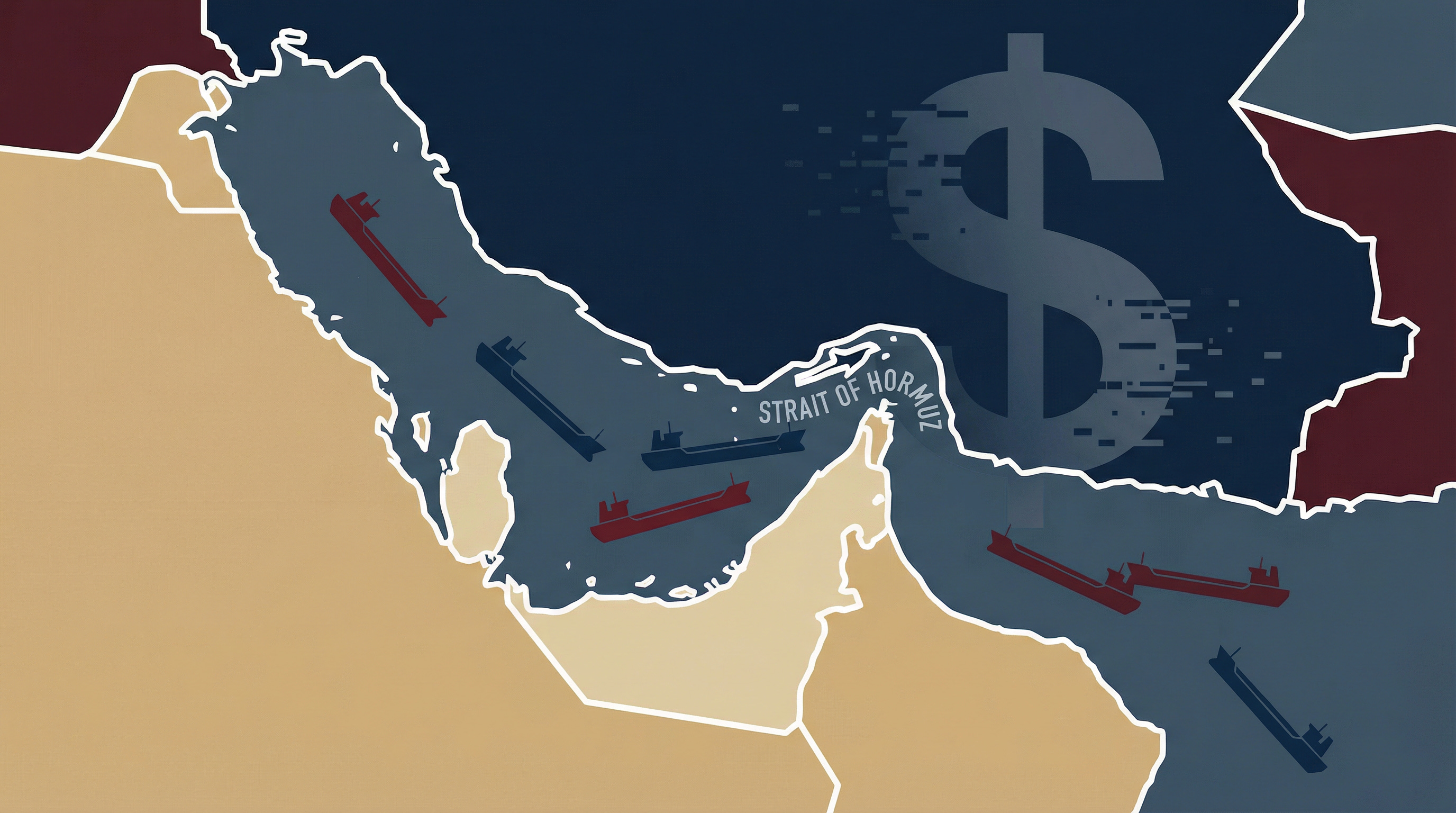
The United States has walked into a moment where the usual vocabulary of “options,” “proportionate responses,” and “off‑ramps” no longer applies. When the Trump administration chose to turn a chronic standoff with Iran into open war—just as global debt, de‑dollarization pressures, and Gulf fragility are all peaking—it converted a regional crisis into a structural test of America’s entire post‑1973 order. This is not “another Middle East war.” It is a go‑for‑broke move with three fused stakes: the security of the Persian Gulf, the credibility of U.S. military primacy, and the survival of a dollar system that depends on both. If Washington escalates and then backs off without hard, visible gains, the damage will not be confined to prestige or a modest effect on yields; it will go straight to the question of whether the United States can keep global primacy and its position as the center of an energy‑backed finance and security architecture.
For fifty years, the “petrodollar system” has rested on more than the fact that oil is priced in dollars. It has been built on a bargain: the United States guarantees Gulf regimes and sea‑lane security, and in return key producers price oil in dollars and recycle their surpluses into U.S. assets, anchoring global energy trade around the dollar and U.S. Treasuries. That arrangement has allowed America to run larger and more persistent deficits than any normal country could sustain. But the bargain has been quietly fraying. Central banks have diversified reserves, alternative payment systems have spread, and U.S. financial coercion has nudged rivals to experiment at the margins. The Iran war arrives just as investors, adversaries, and allies are asking whether Washington still has the will and capacity to underwrite the security side of the deal. Tehran understands this. Iran does not need a clean battlefield victory over the United States. It needs to survive, maintain a credible ability to threaten the Strait of Hormuz and nearby shipping lanes, and demonstrate that the hegemon can no longer impose its will at an acceptable cost. If, after a U.S.‑led campaign, the Iranian regime is intact and still able to menace flows through the Strait and intimidate Gulf monarchies, the conclusion for serious actors will be that the security guarantee behind the petrodollar has turned from solid to contingent.
Thanks for reading! Subscribe for free to receive new posts and support my work.
The most dangerous outcome of this war is not simply a spike in oil prices or a handful of disabled tankers; it is an Iran that emerges with a credible, durable capacity to deny or intermittently disrupt the energy outflows of the Gulf monarchies while remaining in power. Crucially, in that failure scenario the status quo doesn’t just “leave Iran with the ability to close Hormuz in extremis.” It creates a new equilibrium in which open disruption of markets becomes a standing tool of statecraft that pays for itself. Every time Tehran chooses to stoke tension, harass shipping, or damage infrastructure, oil prices jump—and so do Iranian revenues. Disruption becomes a rentable asset: a lever Iran can pull at its leisure to generate both fiscal windfalls and political leverage.
That shift is what turns this from a narrow military problem into a structural threat to the currency order. Iran does not have to own the Gulf to get there. It needs the demonstrated ability to mine the Strait of Hormuz, strike loading terminals and offshore facilities, and periodically damage tankers and pipelines. Once markets internalize that Iran can toggle this risk on and off, they start to price in Iranian discretion as a structural factor. Hormuz risk ceases to be a tail event and becomes a semi‑regular feature that traders, refiners, and treasuries must assume will recur whenever it suits Tehran’s interests—political or fiscal. Because the Gulf monarchies’ survival is welded to steady energy exports, a Tehran that can shut or sharply constrict their revenue stream whenever it wants holds a standing veto over their foreign policy.
At the center of that foreign policy sits the dense lattice of U.S. facilities—air bases, naval headquarters, and logistics hubs across Qatar, Bahrain, Kuwait, the UAE, and Saudi Arabia—that physically embody the “oil for security” bargain. In a world where Iran can strangle their exports at will, it does not have to defeat U.S. forces outright. It can quietly present Gulf rulers with a stark choice: either limit U.S. operations from your territory, refuse new deployments, and eventually press for reductions in American basing, or watch as missiles, drones, proxies, and maritime disruption make your export infrastructure—and therefore your regime—intolerably vulnerable. Over time, that kind of leverage hollows out U.S. basing rights through quiet restrictions, parliamentary theatrics, and back‑channel understandings. Gulf states hedge harder, inviting more Chinese investment and weaponry, exploring security understandings with Russia and even Iran, and experimenting with non‑dollar invoicing or mixed‑currency contracts. The habit of pricing and recycling exclusively in dollars, already under stress, becomes openly negotiable.
That is what makes this war existential. The petrodollar has always been a two‑part contract: dollars for oil, and U.S. force for regime and sea‑lane security. An Iran that can not only credibly strangle the Gulf kingdoms’ energy outflows but also monetize episodic disruption—using it as a “tax” on global markets that funds its own coercive apparatus—threatens both halves of that contract at once. Leaving Tehran in that position is not “living with some risk.” It is accepting a future in which Iran has a standing lever to squeeze our hosts, push our bases out of the Gulf, and gradually push the dollar off the top of the energy system those bases were built to protect, all while being paid in higher oil revenues every time it flexes.
All of this is why the usual talk of off‑ramps and “escalation ladders” no longer fits. Once Washington escalated to sustained strikes inside Iran and accepted the risk of major disruption in Hormuz, the war stopped being about sending messages. It became binary. A system‑preserving outcome is not that “capabilities were degraded.” It means Iran’s ability to shut or seriously menace Hormuz and adjacent chokepoints is materially broken; the islands, coastal batteries, and key facilities that give Iran coercive control over tanker traffic are destroyed or physically seized and held; nuclear and major missile and drone sites are secured or sufficiently wrecked that Iran cannot quickly rebuild a credible regional deterrent; and Gulf monarchies and markets conclude that the United States has reasserted control over the energy arteries and the bases that guard them. Anything short of that—a still‑risky Hormuz and a newly institutionalized Iranian “business model” of paid disruption—is strategically a loss. Iran may be battered, but if it can claim survival and a continuing ability to rent out crises in oil markets while leaning on Gulf rulers, it wins the real bet.
This is also why arguing about marginal war costs misses the point. Underneath the strategy debate is a fiscal and monetary reality that U.S. politics mostly sidesteps. America’s current debt load and budget path are barely sustainable with reserve‑currency status and a Gulf‑anchored energy order. Strip away that premium, and you do not just get a weaker dollar; you get structurally higher borrowing costs, faster growth of interest outlays, and a rising risk that concerns about solvency become self‑fulfilling. In that light, once Washington chose open war with Iran in this macro environment, the standard cost‑benefit frame stopped applying. From a narrow budget perspective, this war is clearly expensive and dangerous. From the standpoint of the system that lets the United States carry its current obligations at tolerable rates, the relevant question is no longer “how much does it cost?” but “does this end in a way that stabilizes the architecture, or accelerates its collapse?”
That is where the “necessary heresy” comes in. For years, American officials have talked about thinning U.S. forces in Europe to focus on higher‑priority theaters, only to be pulled back by alliance politics and congressional guardrails. The new defense strategy formally prioritizes the homeland and the Indo‑Pacific and implies that Europe should carry more of its own weight. Yet on the ground the United States still keeps large formations in a continent that is rich enough and armed enough to assume primary responsibility for its own defense. The Iran war changes that calculus. Because the core of U.S. financial and strategic power is centered on the Gulf, that is where additional American brigades now do the most to protect it—not in Europe’s rear garrisons. Since this war is existential for the petrodollar, Europe is, harshly, where you go shopping when you need serious ground power.
That logic leads to a ruthless but coherent sequence. First, re‑rank the theaters: in an existential contest over the Gulf and the currency system, brigades belong closer to Hormuz than to the Rhine. Second, accelerate European strategic autonomy. Pulling U.S. forces out of rear garrisons is not abandonment; it is the overdue handoff, and Europe can and should take primary responsibility for deterring Russia. Third, use Iran as a training ground for Asia: the same heavy formations that fight their way through an Iran campaign will come out experienced, integrated, and logistically hardened—the kind of force you would want at the front line of any serious China contingency. Once the Gulf is relatively stabilized and Gulf rulers no longer feel coerced into edging U.S. bases off their soil, those units can be reoriented toward the Indo‑Pacific, finally aligning posture with stated priorities.
Seen from that angle, the Iran war is not just a risk; it is also the opportunity for a transition that U.S. elites have been talking about but not executing. It can be the moment when Washington concentrates on the two pillars that matter most: the Gulf order that props up the dollar today, and the Indo‑Pacific balance that will shape its fate tomorrow. Or it can be the moment when the United States fights with half‑measures, leaves Iran not only with a credible denial capability but with a profitable, repeatable disruption racket, watches Gulf rulers hedge and chip away at U.S. leverage under Iranian pressure, and discovers too late that it has lost not just a war on the margins but the financial privilege that made all its other choices possible. There is no glide path out of this dilemma. Total victory must be achieved. The bets have been placed; now it is time to play our hand.