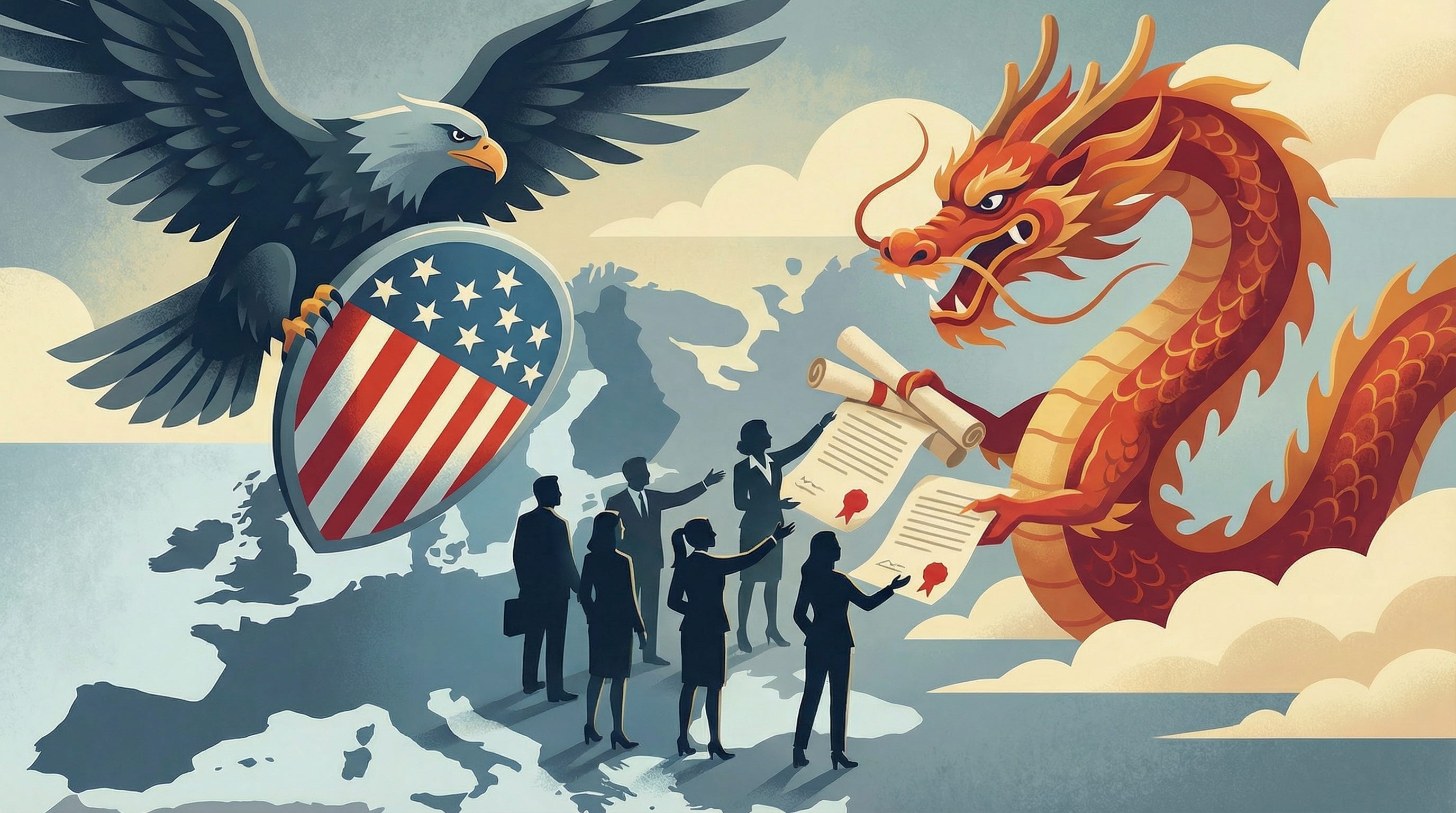
Europe’s response to the Hormuz crisis has exposed a deeper pattern in the transatlantic relationship. Publicly, European leaders insist they remain committed allies. Privately, their behavior looks very different: they are refusing U.S. requests for real risk‑sharing, edging toward China economically, and still assuming that American defense guarantees will be there no matter what. It is the behavior of a junior partner that thinks it can humiliate a patron and get away with it. On Hormuz, the pattern is stark. Trump has requested that NATO allies and other partners send warships and minesweepers to help reopen the strait and escort commercial shipping. European governments have largely said no, arguing this is “not Europe’s war,” questioning Washington’s endgame with Iran, and publicly signaling that they will not be dragged into an open‑ended U.S.‑driven conflict. At the very same time, these same governments treat the U.S. nuclear umbrella, high‑end intelligence, airlift, and forward bases as a given, with many still below the 2 percent of GDP defense target and counting on U.S. forces in Germany, Poland, Romania, Italy, and the UK to deter Russia and stabilize their neighborhood. The implicit message is: “We reserve the right to say no when your request is inconvenient for us, but we expect you to come running when we call on you.”
Layered on top of this is Europe’s China strategy. EU policy documents and elite rhetoric are explicit that Europe seeks “strategic autonomy” not only from Washington but from Beijing, and rejects any idea of clean “decoupling” from China. In practice, that has meant resisting U.S. pressure to fully align on technology controls and supply‑chain re‑shoring, talking about “de‑risking” while remaining deeply integrated with Chinese markets and manufacturing, and positioning the EU as a third pole that can play off U.S.–China rivalry to its own advantage. Meanwhile, U.S. tariffs and industrial policy moves have sought to establish more equitable, reciprocal trade terms with European exporters, and Europe has responded by leaning harder into Chinese trade where it can. The net effect, from Washington’s vantage point, is simple: Europe is happy to keep American sacrifice—in the form of its security umbrella—overhead while it courts Beijing and tries to carve out room to maneuver against U.S. interests.
Strip away the diplomatic language and the pattern is brutal in its simplicity. Europe refuses to assist in missions the U.S. cares about and chooses to work against U.S. interests when it sees advantage in doing so, even as it remains heavily dependent on U.S. expenditures and hard power at home. The implications are clear: Europe is treating the United States as a taken‑for‑granted protector it can embarrass in public, empower its rival, and quietly bet will never actually walk away. For Americans who remember two world wars on European soil, the Marshall Plan, decades of forward deployments, and support for Ukraine to soothe European security fears, watching Europe reject U.S. calls for assistance over Iran while deepening integration with China makes that behavior feel less like partnership and more like opportunism.
The deeper problem is structural. As long as Washington’s exit threat remains weak—symbolic drawdowns here, angry speeches there, but no fundamental change in posture—Europe has every incentive to continue selfishly pursuing its own goals at America’s expense. It can squeeze what it can from U.S. protection, distance itself from U.S. calls for reciprocity, and cultivate China for leverage and markets, all while assuming that, in the end, the American security umbrella will still be there. From a U.S. perspective, that is the real humiliation: not just that Europe is acting this way, but that the United States continues to treat a self‑absorbed actor as an indispensable partner. At some point, the only honest response is for the United States to show some self‑respect, respect Europe’s moves to chart its own independent path, and insist that it shoulder the full burden of its own security as an independent entity.
Thanks for reading Trent Watch ! Subscribe for free to receive new posts and support my work.